
____________________________________________________________
THE FASTEST TRAIN IN CALIFORNIA 
For some folks, a good trip is defined less by the time to the destination and more by the journey itself. For the vast majority of travelers, however, the opposite is true. “How long does it take to get there?” “What is my ETA?” “Are we there, yet?” The GPS in most automobiles shows you the quickest route to your destination—not the longest. As a people, we are captivated by speed.
What was the “fastest train in California,” and how fast did it go? Of course, “fast” is a relative term. What was fast a century ago would be seen today as slow as a dog sled in a yacht race. Until the advent of maglev trains rail travel was hindered by track friction and condition. For example, in 1911 the Porterville Northeastern track to Springville could accommodate a passenger train travelling at 25 mph—a “quick” 1hr and 15 min. trek. But, by the time of its demise in 1934, track deterioration slowed the train to only 8 mph.1
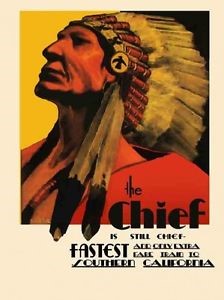
Beginning in 1928, the AT&SF advertised the “Chief” as the fastest train to Southern California. In its debut, pulling a standard Pullman consist, it covered the 2,228 miles between Chicago and L.A. in 61 hours and 15 minutes.—a rocket fast time in 1928. By 1937, with track and motive power improvements, the Chief made the same trip in just under 51 hours, but would be eclipsed that same year by its cousin, the “Super Chief” (aka, the “train of the stars” after its popularity with Hollywood royalty).
“The Super Chief (Nos. 17 and 18) was the first Diesel-powered, all-Pullman sleeping car train in America . . .”2 In May, 1937, a lightweight consist of the Super Chief–averaging 60 mph and reaching 100 mph on some segments–made it to Chicago in 36 hours and 39 minutes. As far as I can tell, that’s the winning time and the title of “Fastest Train in California” goes to the Super Chief. (Note: The regularly scheduled run of standard Pullman cars from L.A. to Chicago logged a time of under 40 hours, averaging about 57 mph)
AT&SF ran the Super Chief until 1971 when Amtrak took over passenger service. Amtrak renamed the train “Southwest Chief” and advertises it today as a journey of more than 40 hours (averaging less than 57 mph).
In contrast, the fastest operating train in the world (not a test run) was achieved in France in 2007 when their high-speed passenger train accelerated to 357 mph. More recently, a Japanese train reached 375 mph in a test run. California’s high-speed rail is projected to reach speeds up to 220 mph on some segments (much lower on other segments).
- The Southern San Joaquin Valley, A Railroad History, by John Bergman, 2009, p. 37-40.
- en-wikipedia/wiki/super_chief
- michael.railhistory.railfan.net
- american-rails.com/super-chief.html
________________________________________________
 American Flyer Guy